Palantir Foundry: three layers, and why the FDSE job ad never names it
Palantir calls Foundry an operating system for enterprise data. What a forward deployed engineer actually has to master sits in the middle layer: the Ontology, a digital twin of the whole organisation.
In brief
- Palantir defines Foundry as an operating system for enterprise data, built from datasets, an Ontology and applications.
- The Ontology, a digital twin of the organisation, is the layer an FDE must understand most deeply, because it turns raw data into business concepts.
- Palantir's FDSE job ad does not mention Foundry; it talks about customer problems. The platform is the tool; the skill being hired is understanding the problem.
Palantir’s official job ad for a Forward Deployed Software Engineer does not mention Foundry once. Meanwhile FDE Academy, a training site outside Palantir, argues that the FDE role exists precisely because Foundry and its predecessor, Gotham, needed engineers embedded on the customer side.
The two are less contradictory than they look. FDE Academy treats Foundry as the place where most FDE work happens, but Palantir’s job ad describes someone who works directly with customers to quickly understand their biggest problems, not someone who has mastered a tool.
So to understand Foundry, start with the problem it was built to solve. If you are aiming for an FDE role, there are three things to grasp: what Foundry consists of, which layer an FDE touches, and what to learn before you ever get an account.
Three layers, and the middle one is where the value is
Palantir’s official documentation, updated on 2 July 2026, defines Foundry as an operating system for enterprise data that allows data to be integrated from any source. The 10-K for fiscal year 2024 uses the same language: Foundry creates a central operating system for an organisation’s data.
“Operating system” is a deliberate comparison: not a data warehouse, but the thing every other application runs on.
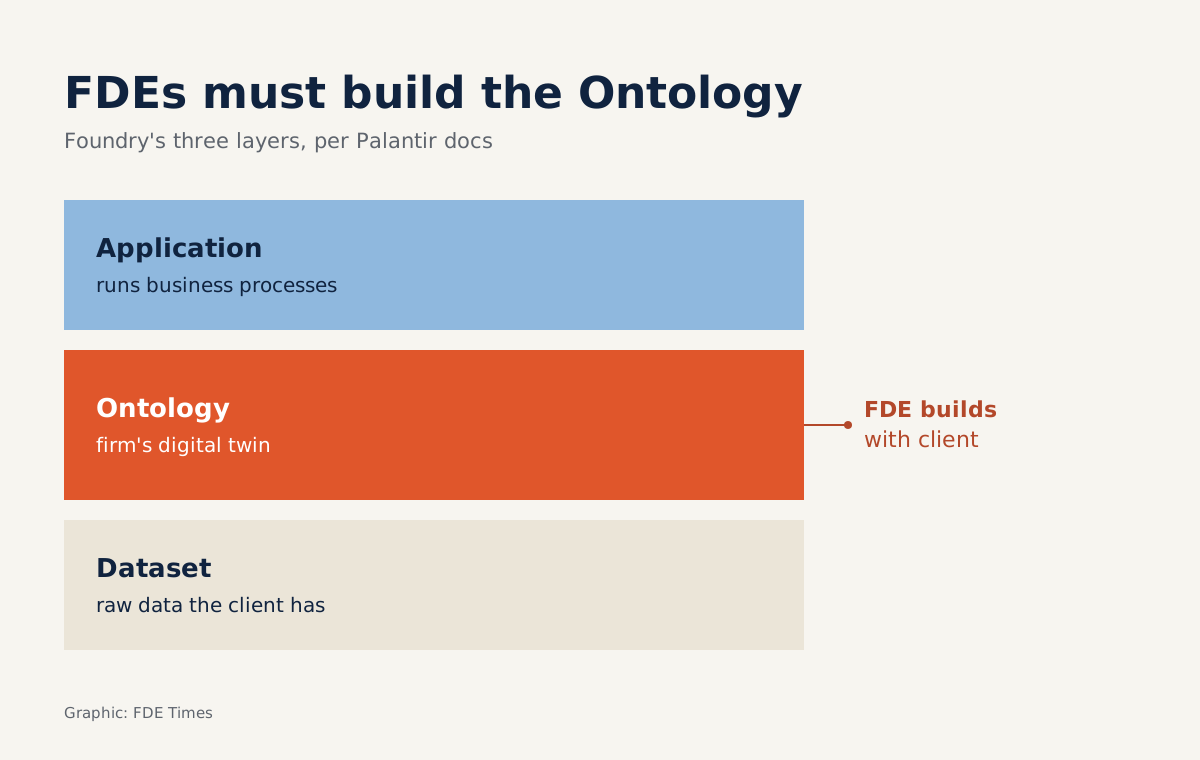
The architecture is described as two data layers plus an application layer. Raw data lives in datasets. Above them, the Ontology maps datasets and models to real-world concepts, and the Ontology documentation calls this layer the digital twin of the organisation.
At the top sit applications, which draw on both layers to run business workflows. Applications do not only read the Ontology; they consume both datasets and the Ontology. The middle layer does not replace raw data. It adds a layer of meaning that raw data lacks.
FDE Academy calls the Ontology the thing that truly separates Foundry from an ordinary data platform. That is a third party’s judgement; Palantir’s documentation only describes the Ontology as the organisation’s digital twin and makes no comparison with other platforms.
Picture a day of deployment
Consider a hypothetical case: a factory in Binh Duong, an industrial province in southern Vietnam, keeps its machine data in three places: an ERP system, manufacturing execution software, and a spreadsheet kept by the maintenance team. At the dataset layer, the first job is to bring all three sources into Foundry, exactly as the promise to “integrate data from any source” suggests.
At the Ontology layer, you declare the factory’s real concepts: Machine, Production Shift, Incident. A Machine has an ID and a location; an Incident links to one Machine and one Shift. At the application layer, the maintenance team opens a screen showing which machines have incidents and which shifts are affected, and acts on it right there.
The hard part is not knowing which button to press. It is deciding what “Incident” means: does a technician call it an incident when a machine stops for five minutes, or thirty? That is a customer discovery question, and no documentation will answer it for you.
That may be why Palantir’s job ad talks about customer problems rather than the platform.
The same ad says FDSEs work in small teams with minimal supervision and own end-to-end execution of high-stakes projects. In the hypothetical above, “end to end” means one person touching all three layers, from dirty datasets to the screen the workers use.
Foundry does not stand alone
Foundry is one of Palantir’s four platforms. AIP, the generative AI layer, is packaged with Foundry, Gotham and Apollo; Apollo is the layer that controls delivery. For an FDE, Foundry is where modelling and workflow building happen, while shipping software into customer environments and wiring AI into workflows sit in other layers of the same suite.
Palantir’s ambition also extends beyond a single customer. The 10-K says Foundry is becoming the central operating system not just for individual organisations but for entire industries. If that holds, one customer’s Ontology is not an end product but a piece of a larger picture, and the FDE is the person who builds each piece.
What to learn before you get an account
You cannot practise Foundry the way you practise an open-source library, but the skill underneath it can be practised right away. Take a system you have worked on and write out its business objects, properties, relationships and actions, as if you were declaring an Ontology.
If you cannot explain to an outsider why you chose this object rather than that one, you are not finished.
On your CV, do not write “built ETL pipelines”. Describe a time you pulled data from several sources into a model that non-technical people used to make decisions. In job descriptions, look for phrases such as “own end-to-end”, “small teams” and “minimal supervision”: that is the language of Palantir’s FDSE ad.
That ad does not mention Foundry or its layers. But if you own a project end to end, you should be able to work across all three layers rather than excel at just one.
Foundry may be where the work happens. But what Palantir hires is someone who can turn a messy factory into a digital twin the workers trust; the platform is just where that twin is stored and run.
Was this article useful?
Thanks for the feedback!