Full Stack Open from the University of Helsinki: a free course from React to containers, and how FDEs should take it
The course launched in 2019 for a reason tied to job ads. It remains one of the cheapest ways to learn to read a client's JavaScript codebase.

In brief
- Full Stack Open is free and runs from Part 0 to Part 13. Matti Luukkainen wrote most of it; the TypeScript, CI/CD and container parts were contributed by people from outside the university.
- The course is text and exercises only, with no video, and is not meant for people who cannot yet program.
- For FDEs, its value is that it covers the layers you will meet in a client's systems: frontend, API, types, pipelines and containers.
When the course launched in March 2019, Matti Luukkainen of the University of Helsinki gave a very down-to-earth reason for it: “full stack” was the phrase that appeared most often in job ads. He added that anyone who finished it could work as a junior developer.
Seven years later, Full Stack Open is still free. The curriculum now has 14 parts, from Part 0 to Part 13.
For a Forward Deployed Engineer, the reason to take the course is a little different from that of someone looking for a junior job. On a client site, you rarely get to choose the technology.
You have to be able to read their React frontend, call their Node API, fix a TypeScript file and understand why their CI pipeline has gone red. This course teaches all of those layers, in the order in which they stack on top of one another.
Who made the course, and what does it teach?
The course’s full name is Full Stack Open, with the subtitle “Deep Dive Into Modern Web Development”. The official site is fullstackopen.com. The University of Helsinki built the course with Houston Inc. In June 2019 the university announced the English version, with the aim of bringing Finnish university education to international learners for free, and Luukkainen as coordinator.
Luukkainen wrote Parts 0 to 8 and Part 13. The remaining parts were contributed by people from outside the university: Part 9, on TypeScript, by developers at Terveystalo; Part 11, on CI/CD, by a developer at Smartly; and Part 12, on containers, by Jami Kousa.
The core of the course is building a single-page app with React. Around that sit Node/Express, testing, GraphQL, React Native and relational databases.
According to its About page, the course is free, comes with a certificate and earns University of Helsinki ECTS credits. All the material lives in a public GitHub repo with thousands of forks.
Which FDE skills does it build?
Picture a first week on a client site. The client wants an internal dashboard that pulls data from an existing API, to demo to the leadership team on Friday. You need to set up a React app, write a thin Node layer to collect and clean the data, add TypeScript types so nothing breaks when the schema changes, then package it in a container so their IT team can run it.
Each task on that list maps to a part of Full Stack Open. The real skill being trained is not any single framework. It is understanding how data moves through each layer, and where the error shows up when a layer breaks. That is also what you need when debugging someone else’s system at midnight.
Who should take it, and in what order?
The course is not for beginners. The About page asks that students program well and know the basics of the web and databases. Scrimba’s 2026 round-up of full stack courses recommends this one to frontend developers who want to move into full stack, but says plainly that people who cannot yet program should not choose it as their first course.
Scrimba also points out the cost: the course leans on text and exercises, with no video to fall back on. A learner on the freeCodeCamp forum, who had completed most of the course in 2020, rated it very highly. Even so, this learner advised having some prior React experience, because the text is quite wordy.
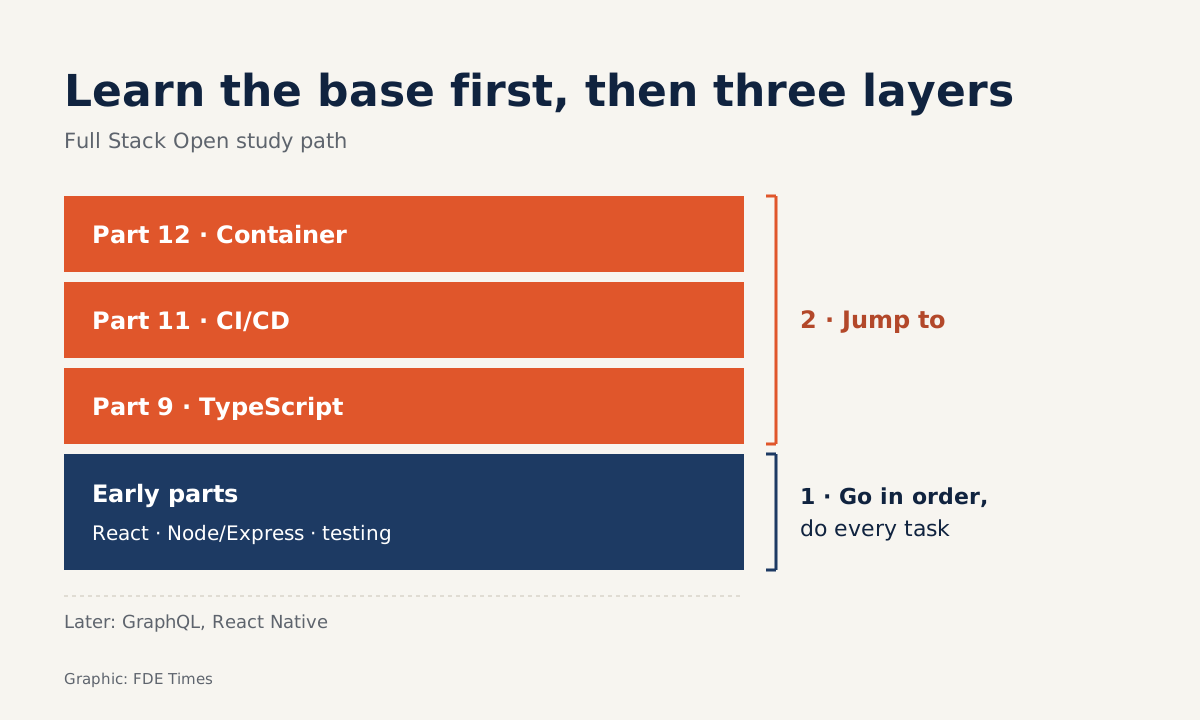
If you are a backend engineer who wants to move into FDE work, go through the early parts in order, where React, Node/Express and testing are taught. Do not skip the exercises, because they are what force you to understand. Then go straight to Parts 9, 11 and 12.
Those three parts were contributed from outside the university. Types, pipelines and containers are the layers that are hard to avoid whenever you have to make your code run on someone else’s infrastructure. GraphQL and React Native can wait until a specific client needs them.
Three things worth keeping
The first is how the course came about. At launch, Luukkainen tied it to job ads: full stack was the phrase mentioned most often. When you read an FDE job description, do the same: list the technologies mentioned, mark the ones you already have evidence for, then study to fill the gaps.
The second is that the text-only format sounds like a weakness but suits the job. FDEs live by reading documentation, READMEs and other people’s code. A few weeks with a long, dry curriculum is good practice for that skill.
The last concerns the licence. The material is released under a Creative Commons licence that bars commercial use without permission. If you plan to reuse the content to train a client’s team under a paid contract, ask for permission first or write your own material.
Turning exercises into a CV
A 2019 article in I-Programmer noted that credits, exercise submission and the final exam were then available only to University of Helsinki students; outsiders took the open version without supervision. Whatever the certificate is worth today, treat your repo as the main evidence, because a recruiter can open it and check for themselves.
Put on your CV one complete, deployed app with tests, a green CI pipeline and a Dockerfile. Add a short sentence describing how you moved data through each layer. That is almost exactly a description of an FDE’s working week.
Luukkainen said that people who finish the course can work as junior developers. For FDEs, the reward is walking into a client’s codebase without getting lost.
Was this article useful?
Thanks for the feedback!
8 sources
- Full Stack open
- Full Stack Open – About the course
- Full Stack Open, an online course in full stack development, now also available in English · 2019-06-03
- Employers are now looking for full stack developers – online course helps coders find employment · 2019-03-15
- Finland's "Full Stack Open" Now Available in English · 2019-07-16
- Best Full-Stack Developer Courses [2026] · 2026-07-26
- Is Full Stack Open good? · 2022-08-05
- fullstack-hy2020/fullstack-hy2020.github.io