Databricks Generative AI Engineer Associate: more than half the marks are for building and deploying apps
If your client already keeps its data on Databricks, the exam's weightings and the course's four modules line up closely with what you will do on your first RAG and agent project.

In brief
- The exam has 45 scored questions in 90 minutes; Application Development and Assembling and Deploying Apps together account for 52%.
- The official course runs 16 hours across four modules that follow the agent lifecycle: RAG, agents, evaluation, and deployment and monitoring.
- Databricks recommends at least 6 months of hands-on experience, so use the certificate to confirm experience, not to replace it.
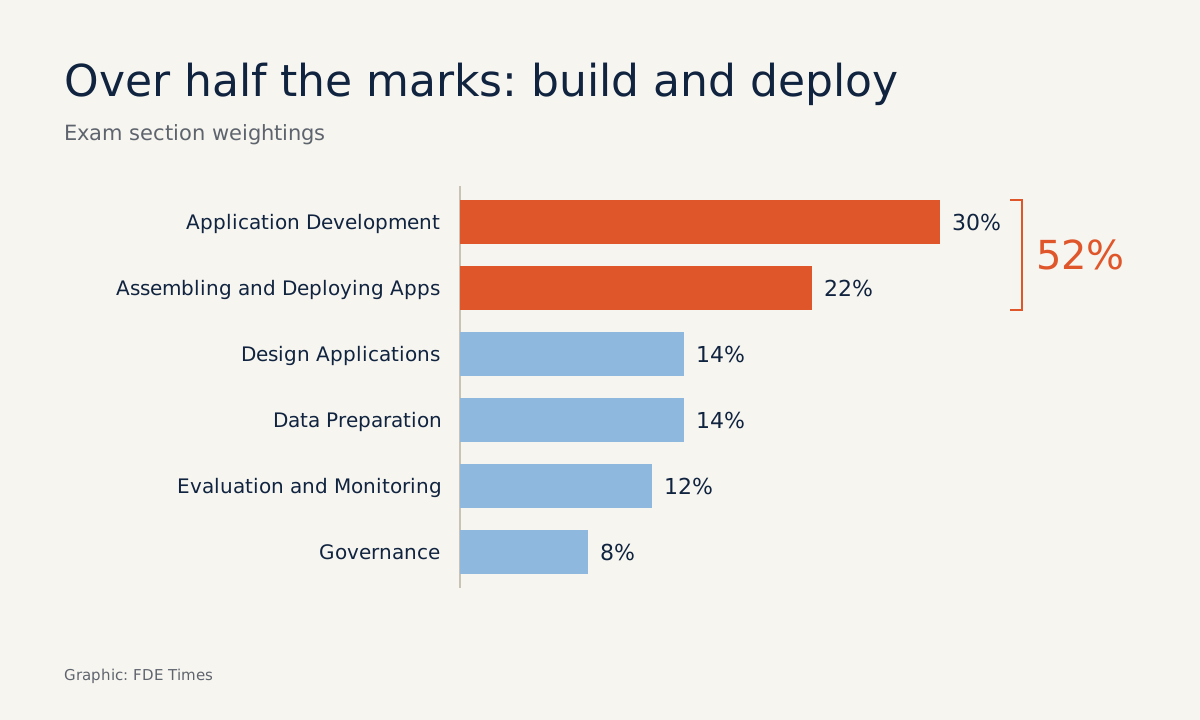
Of the 45 scored questions in the Databricks Certified Generative AI Engineer Associate exam, roughly 23 fall into just two sections: building applications, and assembling and deploying them. Design, data preparation, evaluation and governance together make up less than half the paper.
When a client already keeps its data on Databricks, it does not need a lecture on LLM theory. It needs an agent that can retrieve its documents, runs on the platform it is already paying for, and has someone accountable when it gets an answer wrong.
What does the exam measure, and where is the weight?
According to the official certification page, the exam assesses your ability to design and deploy LLM-based solutions on Databricks. You have 90 minutes for 45 questions, or about two minutes per question. The fee is USD 200 and the certificate is valid for 2 years.
The part most worth studying is the weighting table. Converting the percentages into questions out of the 45 scored ones:
| Section | Weight | Approx. questions / 45 | Matching task at a client site |
|---|---|---|---|
| Application Development | 30% | about 13–14 | Writing retrieval chains, prompts, tool calls |
| Assembling and Deploying Apps | 22% | about 10 | Packaging the agent, shipping it to the client’s environment |
| Design Applications | 14% | about 6 | Choosing an architecture for the client’s problem |
| Data Preparation | 14% | about 6 | Parsing documents, chunking |
| Evaluation and Monitoring | 12% | about 5 | Measuring quality, tracking it once live |
| Governance | 8% | about 3–4 | Permissions, controlling sensitive data |
The implication for revision is clear. If you are strong on design but have never deployed an agent yourself, you are weak in the group that carries more than half the marks. That is also the part to practise first, because an agent that does not yet run on the client’s platform is of no use to them.
In what order should you study?
Databricks recommends at least 6 months of hands-on practice with the tasks in the exam guide before sitting the exam. So the path should begin with doing the work yourself.
The main course is Generative AI Engineering with Databricks, at Associate level. It runs 16 hours, split into four modules of four hours each. It is aimed at data scientists, ML engineers and data practitioners generally, so a software engineer new to the Databricks ecosystem should allow extra time to get familiar with the interface and core platform concepts.
To try it before spending money, start with the free course Building Retrieval Agents on Databricks. Databricks presents it as the first course in the Generative AI Engineering with Databricks series. Its topics, from chunking and Vector Search to Agent Bricks, largely overlap with Module 1, so it works as a trial before committing to the full series.
On the community forum, a Databricks employee said this course is the update that replaces Generative AI Solution Development, and that the old course has moved into maintenance mode. Any study material that still cites the old course name should be checked against the current content.
The four modules form an agent lifecycle
What is most worth learning from this course is how it is ordered, not only what each module contains. Module 1 covers RAG with Agent Bricks: retrieval agents, document parsing, chunking and Vector Search.
Module 2 moves on to agents: tools governed through Unity Catalog and MCP, single-agent and multi-agent systems with the OpenAI Agents SDK, supervisor agents, and MLflow tracing to observe agents as they run.
Module 3 is devoted entirely to agent evaluation with MLflow’s evaluation framework, including custom judges, offline evaluation on curated datasets and online monitoring once live. Only Module 4 reaches deployment: putting the agent on Databricks Apps, integrating tools through MCP, wiring in MLflow Tracing and measuring quality in production.
Picture an insurance client that wants an agent to answer questions about policy terms. Because evaluation comes before deployment in the curriculum, you need an answer to “how do we know it is answering correctly?” before discussing handing the agent to staff.
Three ideas worth keeping
First, chunking is an engineering decision, not a default step. The course puts document parsing and chunking in the very first module, so treat it as a foundational skill and try several splitting approaches on the client’s real documents rather than accepting a preset configuration.
Second, an agent’s tools should go through the platform’s governance layer. The course teaches tool access via Unity Catalog and MCP; at a client site, ask early who manages permissions in Unity Catalog, because your agent will pass through exactly that layer.
Third, evaluation comes before deployment. Evaluation and Monitoring is only 12% of the exam, but at a client site it is what keeps trust intact after the first week in production.
Common revision mistakes
The first mistake is jumping into practice exams in week one. Given the recommended 6 months of practice, practice exams should only be used to find gaps after you have built at least one RAG pipeline and one agent with tools.
The second is studying under old names. Official documentation now describes Agent Bricks as Databricks’ agent development platform and refers to AI Search indexes for data retrieval, while the course description still uses the name Vector Search. Read the current docs alongside the course so you are not caught off guard when you open a client’s workspace.
The third is splitting time evenly across the six sections. The weighting table shows building and deploying applications counts several times more than governance; revise in that proportion, but do not drop any small section entirely.
How does the certificate help an FDE profile?
If you are aiming for an FDE role at a company with many Databricks clients, look in job descriptions for terms such as Unity Catalog, MCP, RAG or agent evaluation.
The certificate tells employers you know the platform’s concepts and tools. A CV line describing a RAG pipeline you built yourself, with your chunking approach and how you measured quality, tells them you have actually done the work.
Do not treat the exam as the destination. Use the weighting table as a skills checklist for your next project: any section you have never done in a real environment is something to do yourself before a client asks about it.
Was this article useful?
Thanks for the feedback!