Internal champions: how to find, test and develop the person who defends your project when you are not there
The person who praises your demo most is often not the one who will defend it when the budget is cut. One simple test tells you which is which.

In brief
- A real champion stakes their professional reputation on the project; a supporter goes quiet once things turn political.
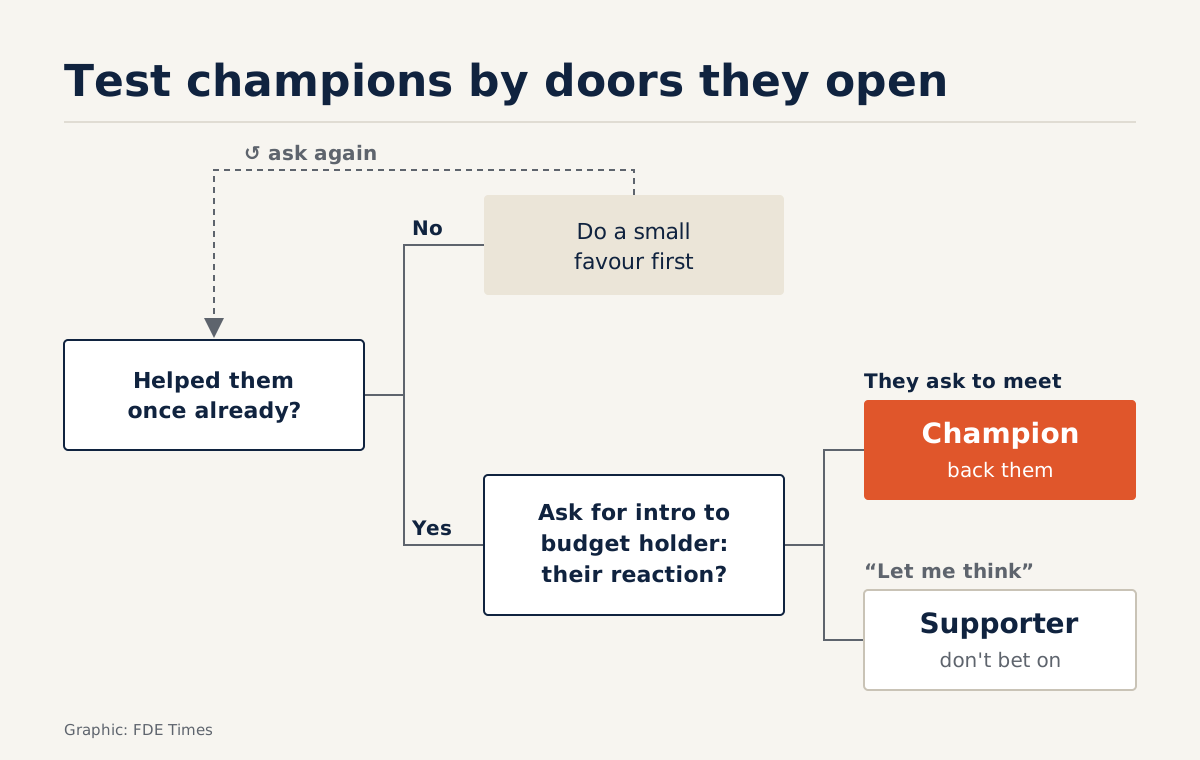
- The quickest test: ask them to get you in front of the person who controls the budget, then see whether it happens.
- A champion needs an executive backing them and needs to be kept honest, or they become an evangelist for a system that no longer fits.
The meeting that decides your pilot’s fate almost always happens without you. It is the client’s leadership meeting, where someone asks whether that agent is worth continuing. The answer depends on one thing: whether anyone in the room speaks up for you.
Coding skill will not save you here. The integration can be clean and the evals can look good, but if nobody on the client side will defend the project when budgets tighten or another department pushes back, your work ends at the demo.
The person who does that defending is called an internal champion. Finding, testing and developing champions is a learnable skill, much like debugging: there is a hypothesis, a test, and a set of signs that you got it wrong.
The person who likes you is not necessarily a champion
A champion combines three things: they believe the solution should succeed, they have real influence, and they can reach the people who make decisions, as UserGems describes it. But the defining trait, according to Spotlight.ai, is that they stake their own professional reputation on the project’s success. Without that, all you have is a pleasant contact.
The most important line therefore runs between a champion and a supporter. When a project gets caught up in internal politics, supporters go quiet and champions step in to defend it. At the demo stage, the two look identical.
Supporter
- Praises the demo, replies to messages quickly
- Goes quiet when the project meets opposition
- Apologises for not being able to introduce you further up
- Loses nothing if the project fails
Champion
- May be sceptical at first and ask hard questions
- Speaks up when the project runs into politics
- Opens the door to the budget holder themselves
- Ties their personal reputation to the outcome
Where to look: at ground level, not at the top
Many engineers instinctively look for the biggest job title. In practice, the backing of a respected colleague often carries more weight than a meeting with a C-level executive, because that person opens a path to stakeholders the org chart does not show you, a point UserGems also stresses.
The first place to look is among end-users: identify them early and you will spot the people who can become your strongest advocates. Close.com wrote that advice for salespeople, but FDEs have an even better vantage point. You sit next to end-users every day and can see who is tormented by the old process and whose opinion the whole team seeks.
In Tryolabs’ FDE model, the first week is about getting into the client’s real environment: mapping the systems and aligning the stakeholders. Do both at once. As you trace a data flow, you will meet exactly the people who operate it, and they form your first list of candidates.
Example: two candidates at a logistics company
Imagine you are deploying an agent to help with vehicle dispatching on the night shift. The first candidate is Minh, the IT team lead, who always replies on Slack within five minutes and praises the demo in front of everyone. The second is Hà, the dispatch shift lead, who asks nothing but hard questions, yet every dispatcher who hits a tricky shift goes straight to her for advice.
Developing a champion is a two-way relationship: you treat them as a colleague and an expert, and you give value before you ask for anything, in the spirit Close.com describes. So your first move with Hà is not to ask for anything. You fix the shift handover report she has been assembling by hand every morning.
Two weeks later, once you have trial data, it is time for the test. The most practical approach is to ask the candidate to get you in front of the budget holder and see whether it happens. It might go like this.
You: Next week I’ll have two weeks of night-shift numbers. Do you think the operations director should see them before the quarterly review?
Hà: Yes. He meets the shift leads on Thursday, so I’ll ask for fifteen minutes. I’ll cover operations, you handle the technical side.
Ask Minh the same question and you get: “He’s very busy, let me see.” That is exactly the line Spotlight.ai draws: a real champion creates access, a supporter apologises for being unable to. Minh is still useful for system access, but Hà is the person to invest in.
A champion needs someone backing them from above
Finding Hà is not the end of it. Implementation champions often feel that leadership gives very little support for adopting new ways of working, according to a study by the Construction Industry Institute. A lone champion will burn out, or be brushed aside by their superiors in the first round of cuts.
Salesforce’s vice-president of Forward-Deployed Engineering says that to get real commitment, you have to raise the conversation to the right level. Champion and executive sponsor are different roles: one pulls from below, the other provides cover from above. That is why the first thing you ask your champion for should be a meeting with that sponsor.
Do not let your champion become an evangelist
There is an opposite risk. A 2005 case study presented at the AMCIS conference warned that a subtle shift from the role of champion to that of evangelist can damage business outcomes, especially when that person is an executive. They keep defending a system that no longer fits.
The safeguard is to keep your champion honest. Give Hà the bad numbers too, including the cases where the agent got it wrong, so she defends the project with data rather than faith.
A more durable safeguard is to turn one person into a group. Tryolabs explicitly lists “an adoption metrics baseline and a trained internal champion group” as deliverables of the adoption phase. A group with data lasts longer than an individual with enthusiasm.
Mistakes that cost you your champion
The most common mistake is confusing the person who replies fastest with the person who has influence, as in Minh’s case. The second is asking before giving: asking a champion to set up a meeting with the director in your first week, before you have solved anything for them.
The third is leaving the champion to carry the project alone, without a sponsor. The last is handing over to a single person. When that person changes jobs, the project is orphaned.
In FDE job descriptions, phrases such as “stakeholder management” or “drive adoption” usually point to precisely this skill. Have a concrete story ready for your CV and interviews: how you identified the champion, which test confirmed it, and what the champion group you left behind could do once you were gone.
Your code runs on the client’s servers. Whether your project survives, though, depends on what one person on the client side thinks, at exactly the moment you are not in the meeting room.
Was this article useful?
Thanks for the feedback!
7 sources
- The Champion Problem: How to Identify a Real Advocate in an Enterprise Deal
- How to identify internal champions to win more deals in B2B · 2025-03-27
- How to Identify Internal Champions to Close More Deals in B2B · 2023-04-11
- Forward Deployed Engineers | Tryolabs
- Salesforce+ Scaling Adaptability: Engineering Leaders Build What's Next
- From Salvation to Damnation: A Case Study on the Role of a System Sponsor in Strategic Downfall · 2005
- The Role of Executive Support in Implementation Champion Success · 2009-09-01