Never Split the Difference: what a former FBI negotiator can teach FDEs about holding scope
The next time a client asks for "just one small extra feature", you do not have to choose between saying yes and pushing back. You can ask the right question instead.
In brief
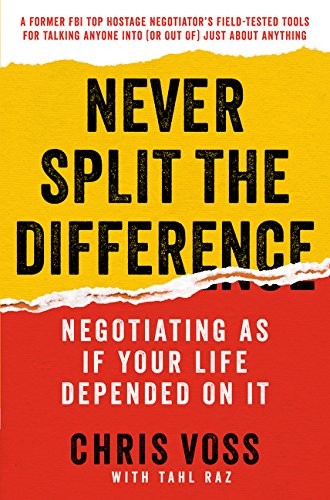
- Chris Voss and Tahl Raz drew on Voss's experience of hostage negotiation at the FBI. HarperBusiness published the hardcover in 2016.
- For FDEs, the book's main value is in holding scope and expectations without damaging the client relationship.
- Three ideas worth keeping: label the emotion and then stay quiet, turn demands into questions, and do not split the difference.
The constraint is the same, but a question draws the client into solving the problem rather than pushing them into confrontation.
Graphic: FDE Times
“How am I supposed to do that?” The question neither refuses nor promises anything. It hands the problem to the person across the table.
Black Swan Group, Chris Voss’s company, uses this line to sum up how Never Split the Difference deals with unreasonable demands.
Most developers who move into forward deployed engineering have been trained thoroughly in systems, but few have been taught what to say when a project’s scope starts to swell. That gap is exactly why the book is worth reading: it offers specific phrases you can take into your next call.
Who wrote it, and how far should you trust it?
The book was written by Chris Voss with Tahl Raz; the original hardcover was published by HarperBusiness in 2016. Penguin Random House UK presents it as a field-tested approach to negotiation from a former FBI hostage negotiator.
Voss now runs Black Swan Group, which sells training built on two branded methods, Tactical Empathy and the Black Swan Method. The company’s website cites a 93% success rate for hostage negotiators, but that is a marketing claim that no independent party has verified.
Read the book, then, as a practitioner’s handbook rather than a piece of research, and test each technique for yourself.
Let the client finish before you answer
Yevgeniy Brikman, who gave the book 5/5 in his review, describes mirroring as a simple way to keep the other person talking and make them feel heard.
The second technique is labeling: naming the emotion you notice in the other person. Brikman stresses the hardest part: once you have named it, stay quiet. An engineer’s reflex is to fill the silence with technical explanation, and that is precisely the urge to resist.
For an FDE, this is customer discovery under pressure. You cannot hold scope until you know what the client actually needs.
Turn ultimatums into questions
Under scope pressure, engineers tend to state a limit: “There’s no time. We’ll have to cut something.” Brikman sums up the book’s advice as taking one of your own demands and phrasing it as a question so it sounds less imposing.
“How am I supposed to do that?”, the line Black Swan Group quotes, is the neatest example of this kind of calibrated question. Instead of “Adding this connector will put us two weeks behind”, you might ask: “How can we add this connector and still hit the go-live date you reported upwards?”
To answer, the client has to look at the same constraints you are looking at, and there is a good chance they will be the one to suggest what to drop.
What do the three techniques look like on a call?
Imagine a client calls in the third week of a project.
Client: “We need a connector for the warehouse system, and go-live still has to be on the 30th.”
FDE: “Still has to be on the 30th?”
Client: “Yes. I’ve already given that date to the leadership team. Pushing it back now would be very hard to explain.”
FDE: “It sounds like you’re under a lot of pressure from above.” Then silence.
Client: “Honestly, my boss just needs to see inventory figures for the main warehouse at the review. The other warehouses can come later.”
FDE: “So how can we get the main warehouse figures into the review without touching the parts that are already working?”
In this hypothetical exchange, the FDE never says “no”. The mirror keeps the client talking, the label draws out the real reason, and the final question turns a full connector into a smaller piece of work that the client proposed themselves.
Don’t rush to split the difference
The book’s title is also its central argument. Brikman puts it this way: compromise is lazy and avoids discomfort, but in the end nobody gets what they really wanted.
On a project, splitting the scope means building half of feature A and half of feature B. The likely result is two unfinished things instead of one that works.
Alongside this comes a different view of the word “no”. According to Brikman, the book treats “no” as the start of a negotiation, not the end. When a client rejects your proposal to cut scope, that is the moment to ask what is making them uneasy, not the moment to give ground.
Who should read it, and in what order?
The book suits developers who have already faced a client, even if only in a demo or a support call. Without that experience, the techniques can sound like tricks. Read Brikman’s review first to get the framework, then read the book, pausing after each technique to try it in your next meeting.
If you want to put this skill on your CV, do not write “negotiation skills”. Describe a specific time you held a delivery date when a client asked for more work, and the question that helped you do it. If a job description mentions “manage stakeholder expectations”, have a story like that ready for the interview.
Technical skill gets you invited into the room with the client. Knowing when to ask “How am I supposed to do that?” is what keeps the project from being swallowed by scope.