Chip Huyen's AI Engineering: a book with little code that teaches FDEs how to decide
Chip Huyen says plainly that this is not a tutorial book. That admission is the reason a forward deployed engineer should read it before any step-by-step coding guide.
In brief
- The author states that AI Engineering is not a tutorial book and contains little code; its value lies in a framework for choosing and adapting foundation models.
- The book favours fundamentals over tools because, in Chip Huyen's view, tools go out of date quickly while fundamentals last longer.
- It suits developers who want to become FDEs: people who must choose the model, the benchmark and the deployment approach for a client, not just write code by following instructions.
- 1Define 'good'Accurate, concise or cheap summaries? Which criterion does the client need first?
- 2Check public benchmarksDo the benchmarks resemble the client's real support tickets?
- 3Build your own evaluation setIf the benchmarks don't match, use a few hundred real tickets as the evaluation dataset
- 4Compare a few modelsRun readily available foundation models on that evaluation set
- 5Adapt and deployChoose how to adapt the model, then put it into production
Support-ticket summarisation example: comparing models only makes sense once 'good' has been defined and a dedicated evaluation set exists.
Graphic: FDE Times
“This is NOT a tutorial book, so it doesn’t have a lot of code snippets.” Chip Huyen wrote that line in the GitHub README for AI Engineering, with “NOT” in capitals. A developer used to learning by typing along with examples may feel a little short-changed. For anyone aiming to become an FDE, it is the opposite: it is the reason the book is worth buying.
FDEs are rarely paid to rewrite sample code. Clients need someone who can stand in front of their problem and choose: which model to use, which criteria to evaluate it against, how to get it into production. AI Engineering teaches exactly that part, the part no tutorial can do for you.
The book only deals with existing models, and that is its strength
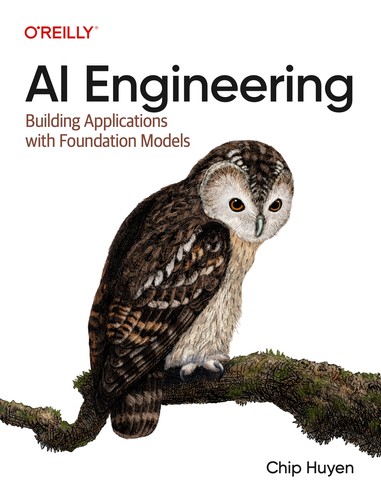
On her book page, Chip Huyen presents AI Engineering (O’Reilly) as a book about the process of building applications with readily available foundation models. The focus is therefore on models that already exist, not on training them.
That is also what application builders do every day: take an existing model and make it solve the problem in front of them.
The book description in O’Reilly’s listing makes a point worth remembering: recent breakthroughs have not only increased demand for AI products but also lowered the barrier to entry. When the barrier is low, anyone can call an API. What separates the good from the rest is the quality of their choices.
Three ideas worth keeping once you close the book
The first is a framework instead of a recipe. The README describes the book as offering a framework for adapting foundation models, and the author’s page adds that it is a practical framework for developing and deploying AI applications efficiently.
A tutorial teaches you to do one specific thing. A framework teaches you to ask the right questions when you meet something new, and FDEs meet something new almost all the time, because every client is different.
The second is fundamentals outlive tools. Chip Huyen writes that tools become outdated quickly while fundamentals last longer, so the book deliberately avoids centring on any particular library or product.
For people working in applied AI, this is self-protective advice: skills tied to a fashionable framework can lose their value within months, whereas the ability to reason about trade-offs travels with you to the next project.
The third is finding your way through a messy ecosystem. The book discusses how to navigate models, datasets and evaluation benchmarks. This is the part closest to FDE work, because when a client asks “which model is best?”, the right answer is rarely a name. It is a series of questions in return.
Imagine a client who wants to summarise their support tickets automatically. Before naming a model, you need to ask: does “good” mean accurate, concise or cheap? Do public benchmarks resemble their actual support tickets, or do you need to take a few hundred real tickets and build your own evaluation set?
Only once those questions are answered does comparing a few models and planning deployment make sense.
Who should read it, and how?
The README says the book is for anyone who wants to use foundation models to solve real-world problems, and that its language is written for people in technical roles. Because the book assumes a technical reader and does not walk you through code line by line, you will get the most from it if you have already built a small LLM application yourself.
Read it differently from a tutorial. Do not open your laptop waiting for code to type along with. Read with a real project in mind, such as a feature at your current company, and after each section ask yourself: if I had to choose today, what would I choose, and why?
The hands-on coding you can learn from the tools’ own documentation. If you have never built an application, the book may feel somewhat abstract; do a few small projects first so you have real experience to measure it against.
Turning a book into evidence when job hunting
Reading a book without leaving a trace gives recruiters nothing to see. For developers looking to move into FDE roles, the best approach is to rewrite your experience in the language of choices. A CV line such as “integrated an LLM into a chatbot” says very little.
Stating that you compared models on the client’s data, how you chose the evaluation criteria and why you picked one way of adapting the model over another says far more.
When reading job descriptions for FDE or AI engineer roles, look for words such as evaluation, benchmark or deployment. These are areas the book covers, so the notes you take while reading can become an outline for interview preparation.
The book is available on Amazon, Kindle and the O’Reilly platform. O’Reilly’s listing gives a release date of 4 December 2024 (ISBN 9781098166304), while the author’s page gives 2025 and says it has been the most-read book on O’Reilly since its launch.
The tools you use this year will change. The question “what should we choose, and why” will remain, and it is the question a client will put to an FDE in the very first meeting.