Up to 50% travel and endless firefighting: how do FDEs keep their engineering skills?
Heavy travel and constant firefighting wear down two different things. A feedback loop into the product protects your skills. Deliberate rotation and an honest travel schedule protect you.
In brief
- OpenAI's job description lists travel of up to 50%, and Palantir prefers candidates who can travel 25-50%. Practitioners say plainly that burnout comes early.
- Travel is not the biggest risk. Endless firefighting and integration work is more dangerous, because the enterprise AI stack is changing so fast.
- The test: does customer work flow back into the product, and does the company have a clear plan for rotation and skill-building?
According to LeadDev, OpenAI’s FDE job posting says candidates must travel up to 50% of the time. Palantir is gentler in its posting for a Forward Deployed Software Engineer. It prefers people who can travel 25-50%, and says the actual amount varies by team and location.
These figures are about more than scheduling. LeadDev notes that constant travel makes the role prone to burnout much earlier than other positions. The global field CTO of Unframe, who does the job himself, says bluntly that the model “doesn’t seem very sustainable”.
Say you are a developer with two to eight years of experience and you are looking at FDE roles. The real question is not whether you can live out of a suitcase.
The question is whether, three years from now, you will be a better engineer or a worn-out integrator who has lost touch with the product. That depends more on how the company designs the role than on your stamina.
Half the year at the customer’s site
Start with simple arithmetic. A year has 52 weeks, so 50% travel means about 26 weeks away from home. Even the bottom of Palantir’s range, 25%, comes to 13 weeks, close to a full quarter.
Time on the road is only the visible part. KDnuggets calls burnout a “structural risk” of the job and ties it to two things: constant context switching, and the fact that the FDE is the company’s face to the customer.
The effect is easy to picture. When you are sitting in the customer’s meeting room, it is hard to say “let me check with the team” and step back. Product failures tend to land on whoever is in the room.
Palantir’s own definition shows the pressure is built into the job description: FDSEs work directly with customers to quickly understand their biggest problems. You are there precisely because the customer has a serious problem.
Picture two weeks at a bank’s headquarters, then coming home to a full inbox and another customer waiting. It becomes clear why time for learning is the first thing to go.
What happens to your skills after endless firefighting?
Travel is not the scariest risk, though. FDE Academy quotes Underdog.io’s warning: if the role turns into an endless chain of integrations and firefighting for customers, you may drift further from core product engineering work than you expected.
The same page stresses that the enterprise AI stack is changing faster than almost any other field. Put the two observations together and you get a double trap. You move away from the core of engineering just when the technology is moving fastest.
Here is what a quarter in that trap looks like for an FDE.
In the first month you write a connector for customer A’s ERP system. In the second you fix a broken data pipeline at customer B. In the third you patch prompt bugs in customer C’s agent. Every job is urgent and useful, but by the end of the quarter you have learned nothing deeper and left nothing behind that can be reused.
The line between growth and burnout
KDnuggets offers a neat test: an FDE role with no feedback loop into the product is just consulting with a nicer title. That is the line that decides whether the role wears you down or helps you grow.
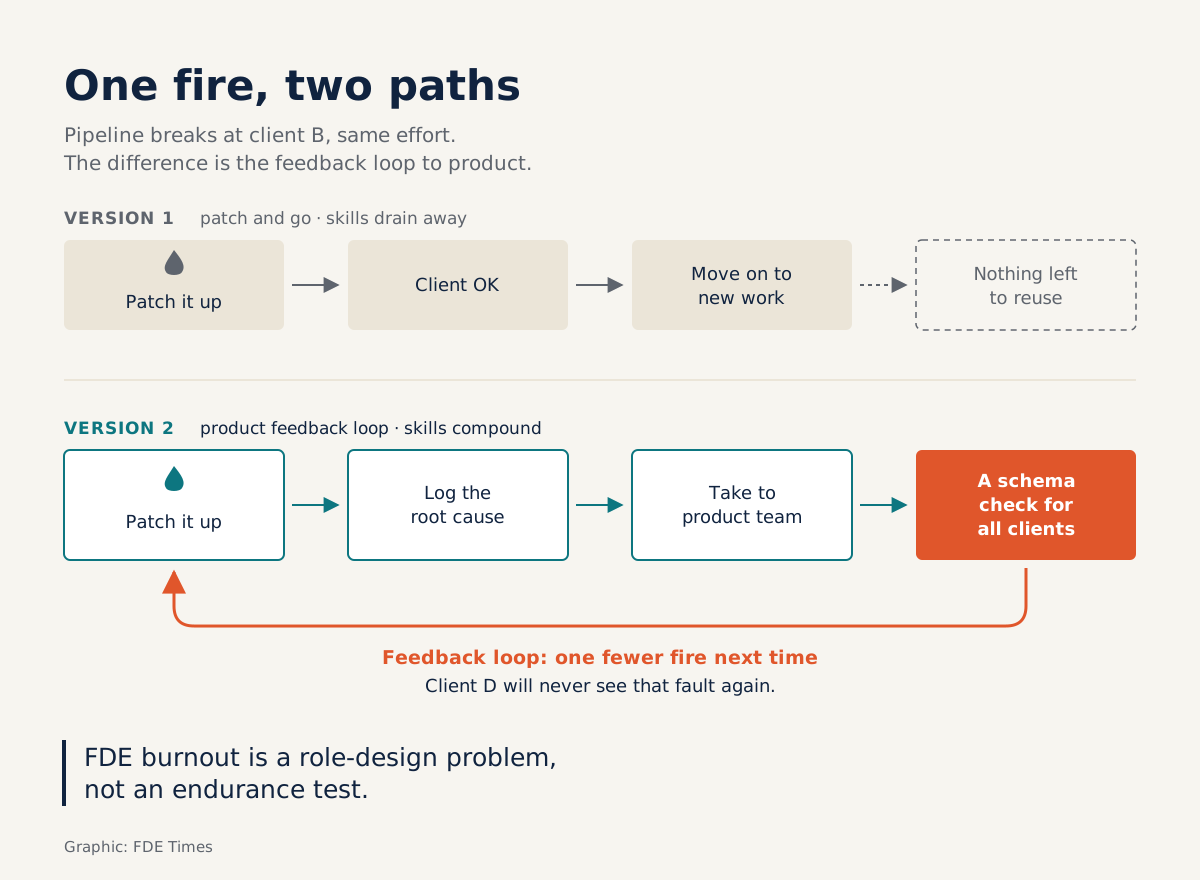
Go back to the broken data pipeline at customer B. In the first version, you patch it so it runs, the customer is happy, and you move on.
In the second version, you still patch it so it runs. But you also record the root cause and take it back to the product team. Three months later it becomes a built-in schema-check feature available to every customer.
Customer D will never hit that problem.
Both versions take about the same effort at the customer’s site. The difference is everything that comes after. The second version makes you think like a product designer, write code that lives in the core codebase, and remove one fire for next time. Your skills build up instead of being used up.
Rotation should be policy, not a reward
A feedback loop protects your skills, but it does not protect you from exhaustion. FDE Academy argues that the common way to reduce the risk is deliberate rotation combined with a skill-building plan.
This is a judgement from people in the field, not a measured result. Still, it fits the logic above: if the pressure is structural, the fix has to be structural too.
The table below lists the pressures practitioners have named, what each one wears down, and a question that helps you spot it before you sign.
| Pressure | Industry signal | What gets worn down | Question to ask in the interview |
|---|---|---|---|
| Heavy travel | OpenAI lists up to 50%; Palantir 25-50%, varies by team | Health, time for learning | How much does this specific team actually travel? |
| Context switching, being the face to the customer | KDnuggets: burnout is a structural risk | Energy, capacity for deep focus | How many customers does each FDE cover at once? |
| Endless integration and firefighting | Underdog.io: drifting away from core product engineering | Design skills, writing product code | How many FDE findings have become features? |
| Fast-changing stack | FDE Academy: enterprise AI among the fastest-changing fields | Foundational knowledge | Is there a rotation plan and time for learning? |
None of these questions has a single “right” answer. What matters is whether the company can answer them concretely. A recruiter who can tell you about an FDE who took a customer finding onto the roadmap is giving you evidence that the feedback loop is real.
How to prepare
When you read a job description, find the travel line first and convert it into weeks. The phrase “varies by team and location” in Palantir’s posting is a cue to ask more questions, not a minor detail.
For roles with customers abroad, each trip also costs flight time and jet lag, so the figure on paper may weigh more than you think.
Many developers in Vietnam who have worked on outsourcing projects are used to a rhythm of “do whatever the client asks”. That is good grounding for FDE work, but it is also the habit most likely to pull you into the first version of the pipeline example. Starting this week, log every firefight in two columns: what applies only to this customer, and what could become a general feature.
On your CV, do not just write “deployed for customer X”. Write what problem you found at the customer, how you took it back to the product, and what later customers avoided as a result. A line like that shows you understand what separates an FDE from a consultant, and serious recruiters will notice straight away.
At your next FDE interview, ask the interviewer to name one customer finding that actually made it onto the roadmap. If they cannot, you are probably about to accept a consulting role with an FDE title.
Was this article useful?
Thanks for the feedback!