For Vietnamese engineers, the way into FDE work runs through labs that want you in the office, not through “Remote” listings
One Forward Deployed Engineer listing labelled “Remote” accepts only US citizens. Meanwhile, the labs that openly require office attendance sponsor visas or help with relocation. Which of these should an engineer in Vietnam go after?
In brief
- An Istari Digital FDE listing says “Remote” but requires on-site work with customers, travel of up to 50% and US citizenship without dual nationality.
- Anthropic and OpenAI promise no remote work: at least 25% of time in the office or 3 days a week, and 25-50% customer travel. But Anthropic sponsors visas and OpenAI offers relocation support.
- For Vietnamese engineers, the word “Remote” matters less than the question “am I allowed to apply?” The way in is through labs willing to bring people over.
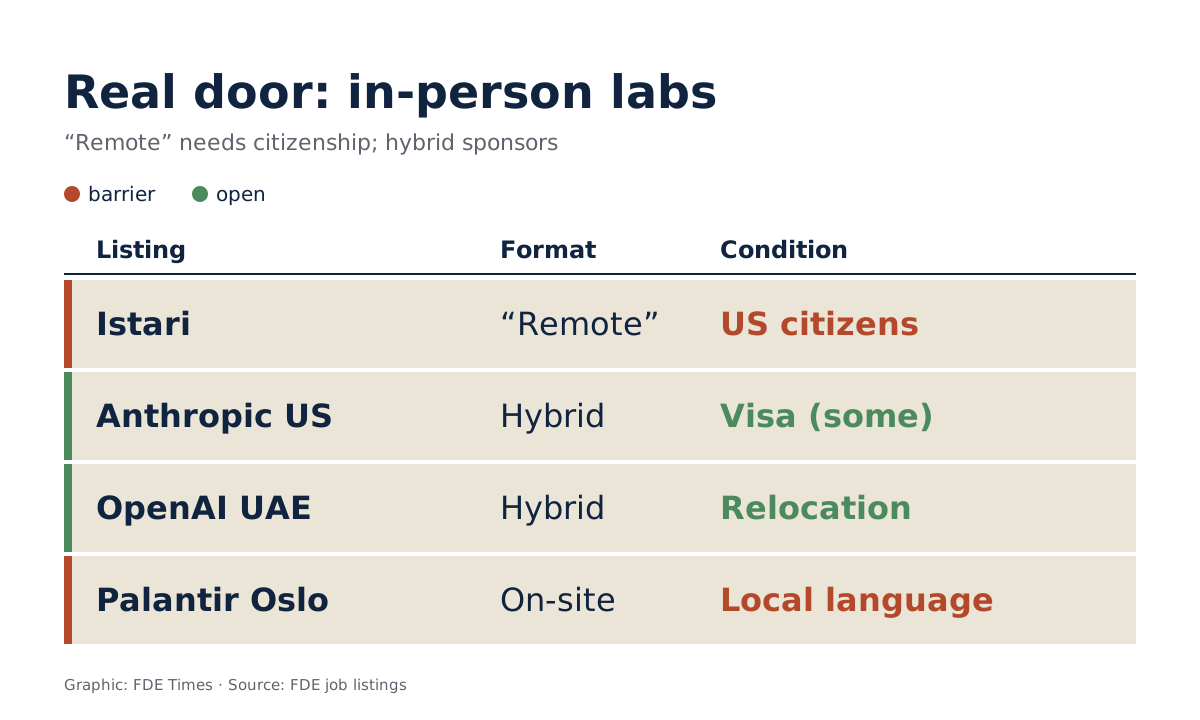
Istari Digital has a Forward Deployed Engineer listing labelled “Remote”, with the word “International” in the job title. Read further down and the picture changes completely: the hire will work on-site inside the customer’s team, travel up to 50% of the time, including to customers in Australia, and must be a US citizen without dual nationality.
For an engineer in Hanoi or Ho Chi Minh City, the word “Remote” at the top of that listing means nothing. Many people hunting for FDE jobs from Vietnam miss this: in a job listing, the work-arrangement label is the least reliable field. What decides things is where you must be, how much you travel, and whether the law lets you apply at all.
Read enough listings side by side and a slightly counterintuitive pattern emerges: the biggest AI labs promise no remote work at all, yet they are where foreign engineers have a more realistic chance. So if you are scrolling LinkedIn and only clicking on listings marked “Remote”, you may be looking in the wrong direction.
“Remote” is a label, not a condition
The Istari listing shows the trap clearly. The “Remote” label does not mean you can work from anywhere. The work still happens at the customer’s site, and you spend nearly half your time on the road.
The biggest barrier is the citizenship line. Requiring US citizenship without dual nationality rules out almost every engineer abroad, however strong the CV. No skill makes up for that line.
That is why a “Remote” listing can cost you several evenings writing a cover letter without ever giving you a chance. The label at the top promises freedom; the conditions at the bottom shut you out.
The labs say it plainly: you must be there
Anthropic’s listings take the opposite approach, honest to the point of being almost uncomfortable. The FDE role in Munich, posted in April 2026, requires frequent customer travel, roughly 25-50% of the time, to work directly with them, along with regular presence in the office.
The listing for the SF, NYC and Seattle offices, posted in August 2026, estimates about 25% travel, depending on location.
The US listing also spells out Anthropic’s general policy: all staff, FDEs included, must be at one of the company’s offices at least 25% of the time. This is hybrid, not remote. But the same listing contains a sentence the Istari listing does not: “We sponsor visas!”.
It needs reading correctly: Anthropic sponsors visas for some roles, not for every role or every candidate.
OpenAI follows the same direction. Its FDE role in the UAE is tied to a specific city, on a hybrid model of 3 days a week in the office, with travel of up to 50% of the time and relocation support. In other words, OpenAI does not expect you to sit at home. It wants you to move to where it is, and is prepared to help you do so.
Palantir, the company that created the FDE role, is the third case. Its FDE listing for the Norwegian government in Oslo is posted as on-site, meaning work from the office, with a preference for candidates who can travel 25-50% of the time. It also requires the local language, a different kind of barrier from citizenship but just as effective at keeping out Vietnamese engineers.
Five listings, one pattern
Put the five listings together along the three deciding lines and the picture looks quite different from reading each one alone:
| Listing | Label / arrangement | Customer travel | Barrier for Vietnamese engineers |
|---|---|---|---|
| Istari Digital (Commercial / International) | “Remote”, but on-site inside the customer’s team | Up to 50%, including customers in Australia | US citizen, no dual nationality |
| Anthropic, Munich | Regular presence in the office | 25-50% | Anthropic’s general policy: all staff in the office ≥25% |
| Anthropic, SF/NYC/Seattle | Hybrid, tied to a specific city | About 25% | In the office ≥25%; visa sponsorship for some roles |
| OpenAI, UAE | Hybrid, 3 days a week | Up to 50% | Tied to a city; relocation support |
| Palantir, Oslo | On-site | 25-50% (preferred) | Local language required |
Across these five listings, the middle column is almost identical: every one requires customer travel of roughly a quarter to half of the time. What separates them is the last column. The listing marked “Remote” is the only one that sets a barrier no personal effort can overcome.
The labs demand that you be there, but they give you a way to get there.
Why do these listings all demand presence?
The identical travel column has a reason. Anthropic describes the travel as a way to build directly alongside customers, while the Istari listing says the hire will sit inside the customer’s team to understand their problems.
DataCamp’s guide to the FDE role, published in July 2026, acknowledges that part of the work can be done remotely. But it also notes that deployments in heavily regulated, high-stakes sectors usually need more presence. The on-site listing for the Norwegian government fits that observation.
DataCamp also points out that the FDE title at PostHog, at Palantir and at a 20-person AI startup describes different jobs. So you cannot infer working conditions from the title or the label, and the five listings above do not represent every employer. Each company’s listing has to be read down to the last line.
How should Vietnamese engineers change strategy?
None of the five listings allows fully remote work. If they reflect the wider market, hunting for a role you can do “entirely from Vietnam” is a bet on something rare.
A more sensible strategy is to target the places willing to bring foreigners over: listings that mention visa sponsorship, offer relocation support, and sit in cities with large offices.
When filtering listings, read them from the bottom up. Look for phrases such as “citizen”, “security clearance”, “visa sponsorship”, “relocation”, “onsite”, “travel up to”, along with language requirements. If a “Remote” listing has a citizenship line, skip it immediately and spend the time on the next one.
Your CV also needs to speak to what the labs are buying. They state travel of 25-50% explicitly, so a CV that only covers backend work and architecture is not enough. Describe specifically the times you worked at a customer’s site, the projects you took to production in someone else’s environment, and state clearly that you are willing to travel and relocate.
For an employer that has to handle your visa, that sentence carries weight.
Outsourcing experience, which many Vietnamese engineers undervalue, can become an advantage if you tell it the right way. Onsite stints in Japan, Singapore or Europe, weeks spent sitting with a customer’s operations team to untangle an integration bug: these are evidence of exactly the kind of work these FDE listings describe.
Finally, remember the limits of the good news: Anthropic sponsors visas for some roles, not all, and OpenAI offers relocation support for a specific city. The door is real but narrow, so each application should be aimed at the right role rather than sent out in bulk.
The word “Remote” in an FDE listing promises you a shortcut. The real door for Vietnamese engineers is in the listings that tell you plainly you will have to be there, and give you a way to get there.
Was this article useful?
Thanks for the feedback!
6 sources
- Forward Deployed Engineer (Anthropic, Munich) – General Catalyst job board · 2026-04-28
- Forward Deployed Engineer (Anthropic, SF/NYC/Seattle) – General Catalyst job board · 2026-08-13
- Forward Deployed Engineer, UAE – OpenAI (a16z job board)
- Forward Deployed Software Engineer - Norwegian Government – Palantir (Lever)
- Forward Deployed Engineer (Commercial / International) – Istari Digital (Lever)
- What is a Forward Deployed Engineer? – DataCamp · 2026-07-17