Delta, Echo or Applied AI: six companies, six names for the FDE role
A job title won't tell you whether you will write code or sit in meetings. Read the job description with two questions in mind: who owns the build, and who owns the outcome?

In brief
- One job, many names: Delta and Echo at Palantir, FDE and Deployment Strategist at Salesforce, FDE in Applied AI at Anthropic, Forward Deployed AI Engineer at Scale AI.
- Palantir itself admits that in practice both of its tracks blend product, engineering and strategy.
- The real dividing line is who owns the build, who owns the problem and the outcome, and whether that person writes production code.
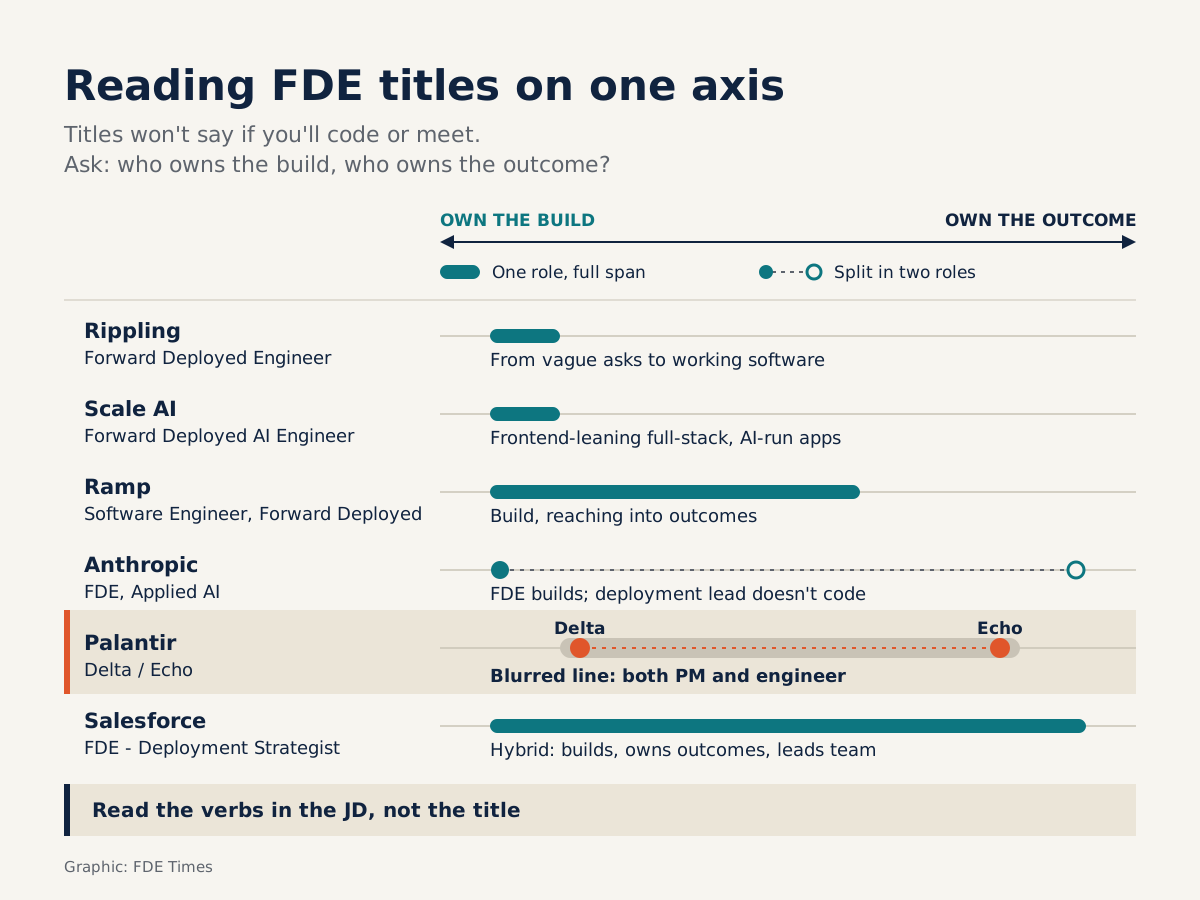
At Palantir, the deployment engineer is called a Delta and the deployment strategist an Echo.
Outside Palantir, the same work goes by many other names. Salesforce hires a “Forward Deployed Engineer - Deployment Strategist”. At Anthropic the title is “Forward Deployed Engineer, Applied AI”. Scale AI advertises for a “Senior Forward Deployed AI Engineer, Enterprise”, while Ramp calls it “Software Engineer, Forward Deployed”. Only Rippling uses the plain title: Forward Deployed Engineer.
If you work as an FDE or want to become one, this tangle of names has a real cost. Type only “FDE” into a job search and you will miss a lot of openings.
Worse, if you assume the title describes the job, you may accept a role in which you never write a line of production code. The right way to read a posting is to ignore the name and look for two things: who owns the build, and who owns the outcome.
Palantir admits its own tracks blur
According to a Palantir blog post quoted by Second Talent, Echo leans towards product management in theory, while Delta leans towards engineering. The next sentence of the same post says the opposite: in practice, both roles are part product manager, part software engineer and part strategist.
The admission shows that even the company that coined the two names cannot keep them apart. Once in the field, a Delta still has to understand the business problem, and an Echo still has to know how the system runs. The title signals emphasis, not scope.
What is worth learning is how they draw the line, not what they call it.
The real axis: who owns the code, who owns the outcome
Second Talent sums up the difference between a deployment strategist and an FDE in a single sentence about ownership: one owns the build, the other owns the problem and the outcome. Place the titles along that axis and things become much clearer.
Anthropic sits at one end. According to Second Talent, it draws the sharpest line: the people who lead deployments there do not write production code. Anthropic’s FDEs belong to the Applied AI team and are sent straight to its most strategic customers to push them to change how they work with AI. In this model, the two jobs go to two different people.
Salesforce goes the other way. It folds Palantir’s two tracks into a single title and describes the role as a hybrid of both. The person in it leads a group of peer FDEs and oversees deployments, which means one person must be technically strong and also answer for the outcome.
Rippling, Ramp and Scale AI lean towards the build. Rippling defines an FDE as a software engineer who works directly with customers, turning vague business requirements into clear technical designs and working software.
Ramp puts “Software Engineer” first in the title, but its FDE team works directly with customers to deliver solutions end to end, so the job stretches into the outcome side as well. Scale AI is looking for a full-stack engineer with a frontend bias to build AI-powered applications.
Read a job description like a vague customer request
The table below places the six titles on the same axis, with a question worth asking in an interview at each company.
| Company | Title | Leans towards | Question to ask in the interview |
|---|---|---|---|
| Palantir | Delta / Echo | Delta: engineering; Echo: product | How do the two tracks actually split the work? |
| Salesforce | FDE - Deployment Strategist | Both, plus team leadership | What share of time goes to writing code, and what share to coordination? |
| Anthropic | FDE, Applied AI | Build, alongside a lead who doesn’t code | Who decides scope: the FDE or the deployment lead? |
| Rippling | Forward Deployed Engineer | Build | At what stage does a vague requirement reach the FDE? |
| Scale AI | Forward Deployed AI Engineer | Build, full-stack with a frontend bias | Does the FDE ship applications to customers or prototypes to another team? |
| Ramp | Software Engineer, Forward Deployed | Build, extending to the outcome | Where does “end to end” actually end? |
Imagine reading a hypothetical posting titled “AI Deployment Engineer”. The title tells you nothing yet. Underline the verbs: if most of them are “design”, “build” and “ship to production”, you are on the build side, like Rippling or Ramp.
If most are “lead”, “oversee” and “define success”, the role is closer to Echo or to Anthropic’s deployment lead.
The exercise mirrors what an FDE does every day on a customer site: take a vaguely labelled request and find the real work underneath. If you can do it with a job description, a recruiter will see that you can do it with a customer.
Write a CV for both sides of the axis
Because every title blends several roles, your CV needs evidence at both ends of the axis. A good bullet point follows the sequence Rippling describes: the vague initial requirement, the technical design you chose, the software that shipped, and the result the customer got.
If you are a backend or full-stack engineer, the build side is already covered. What is usually missing is the outcome side: a time you sat with users yourself, defined what “done” meant, or took on work nobody had assigned you. In the coming working week, find a vague internal request and take it on from start to finish.
Conversely, if you are aiming for an Echo-style role or a hybrid one like Salesforce’s, don’t hide your coding skills. Palantir itself says both tracks require part of a software engineer. Someone who leads a team of FDEs but cannot read code will struggle to keep the team’s respect.
The titles will keep changing, and adding “AI” to the name is probably not the last change. Whatever the title, be ready to answer both questions, who holds the code and who answers for the outcome, in your CV and in the interview.
Was this article useful?
Thanks for the feedback!
6 sources
- deployment strategist vs forward deployed engineer (Second Talent) · 2026-10-05
- Forward Deployed Engineer - Deployment Strategist (Multiple Levels) (Salesforce posting mirror)
- Forward Deployed Engineer, Applied AI (Anthropic posting via General Catalyst)
- Forward Deployed Engineer (Rippling posting via Soma Capital)
- Senior Forward Deployed AI Engineer, Enterprise (Scale AI posting via Accel)
- Software Engineer, AI Forward Deployed (Ramp posting via Redpoint)