Anthropic and Palantir’s FDE job posts don’t ask for AI certificates. They ask what you have shipped
Neither Anthropic’s nor Palantir’s FDE job post mentions a certificate. A training provider admits that finishing a course is rarely enough, and a recruiting platform advises asking candidates directly what code they have deployed to a customer’s infrastructure.
In brief
- Anthropic and Palantir’s FDE job posts list no AI certificates. Anthropic asks for production experience and the ability to find a way through ambiguity; Palantir asks for programming fundamentals and the ability to make decisions with incomplete information.
- The experts quoted by InfoWorld treat certificates as a signal of foundational skill, or as a tiebreaker when two candidates are otherwise equal. They do not replace experience.
- Paraform-style interview questions demand concrete evidence: code running on a customer’s infrastructure, and the hardest challenge you chose to take on yourself.
Anthropic’s job post for a Forward Deployed Engineer, Applied AI, asks for production experience with LLMs: advanced prompt engineering, agent development, evaluation frameworks and deployment at scale. Not one line of it mentions a certificate.
Palantir is no different. Its Forward Deployed Software Engineer post for new graduates asks for an engineering degree and proficiency in at least one language such as Python, Java, C++ or TypeScript. No AI certificate appears on the list.
If you are a developer with a few years’ experience and are thinking of spending several months of weekends earning another AI badge before applying for FDE roles, these two posts deserve a careful read.
Two job posts do not represent the whole market, but the advice from the other hiring sources cited here points the same way: the heaviest item in an FDE application is evidence that you have made software work in someone else’s environment.
What are the job posts actually measuring?
Read closely, the technical requirements in both posts are only a floor. Anthropic even accepts “equivalent experience” in place of a bachelor’s degree. If a formal degree can be substituted by real work, a short-course certificate certainly can.
The deciding part sits in the lines describing temperament. Anthropic wants people with “high agency” who can find their way through ambiguity inside complex organisations, and it estimates roughly 25% of the time will be spent travelling to customers.
Palantir describes the FDE as someone who keeps learning, makes decisions when information is incomplete and does not wait to be told what to do next. That comes with a requirement to travel 25 to 50% of the time.
This is a portrait of someone sitting in a customer’s office, facing a system nobody has explained to them, who still has to make decisions. A multiple-choice exam, however hard, struggles to recreate that scene. So employers look for signals elsewhere.
Even the training side says so
It would be easy to dismiss this as the view of a few large companies. But the experts Bob Violino quotes in an InfoWorld article say much the same. Kyle Elliott, a tech career coach, says plainly that employers are not necessarily looking for candidates with AI certificates.
The article also names two uses for certificates. Matt Scicchitano, who leads SAS’s global certification programme, calls them a tiebreaker when two candidates are equal. Dion Hinchcliffe of Futurum Group sees them as a signal of foundational skill, and is clear that they do not replace experience.
The most striking admission comes from Readynez, a training provider whose business is tied to certificates. It writes that for technical hiring, simply completing a course is rarely enough, and that projects and a tidy repo often carry more weight than badges.
When the people selling the courses say this, it is hard to treat a certificate as a ticket into the profession.
Two questions a certificate cannot answer
Paraform, a recruiting platform, has written a full guide for companies hiring their first FDE. It opens with a blunt claim: résumés lie about FDE readiness. That is the view of an intermediary, not an industry standard. But the questions it suggests are well worth practising.
One asks candidates to show code they have written and deployed to a customer’s infrastructure. The other asks about the hardest technical challenge the candidate chose to take on, not one they were assigned, to gauge their persistence. No certificate helps you answer either.
The Pragmatic Engineer newsletter has noted the same trend. Commure and Matta value hands-on experience building and shipping projects end to end. Ramp prefers seniority for Senior FDE roles but still hires some outstanding new grads, and Palantir takes newcomers with about a year of post-university experience.
That last detail is the good news. The door is not closed to people with few years of experience. It is only hard to open for people with nothing to show.
Which questions can a certificate answer?
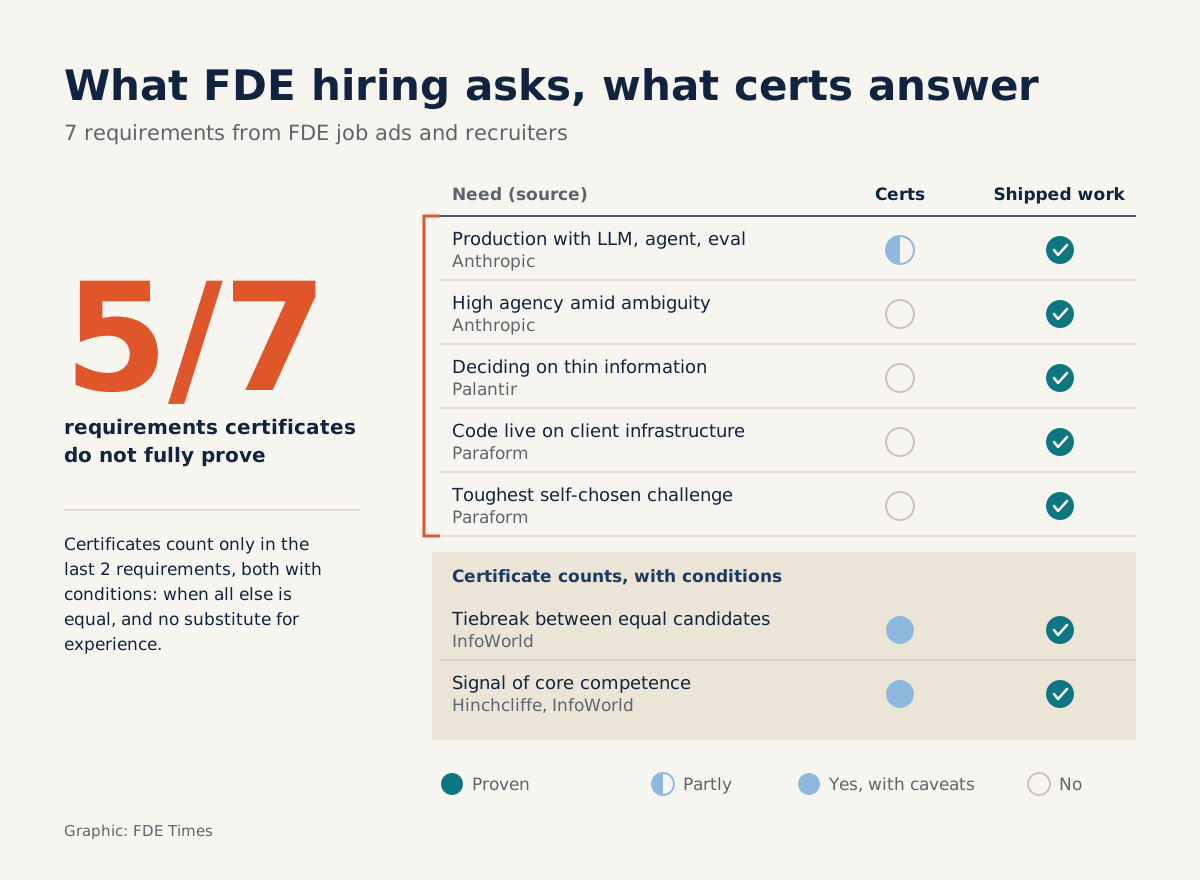
The table below pairs each source’s requirement with a practical question: how far does a certificate go as proof, and what must your project demonstrate?
| Requirement (source) | Does a certificate prove it? | What the project must show |
|---|---|---|
| Production experience with LLMs, agents, evals (Anthropic) | Partly: you know the concepts | A system with real users, an eval suite and a history of bug fixes |
| High agency amid ambiguity (Anthropic) | No | A decision you made yourself while requirements were unclear |
| Making decisions with incomplete information (Palantir) | No | Notes on why you chose direction A over B, and how it turned out |
| Code deployed to customer infrastructure (Paraform) | No | A repo plus a description of the real deployment environment |
| The hardest challenge you chose yourself (Paraform) | No | A story with moments of being stuck, being wrong, and how you got out |
| Tiebreaker between two equal candidates (InfoWorld) | Yes, but only when everything else is equal | A live system, with numbers and users, so your application is not ranked level with others from the start |
| Signal of foundational skill (Hinchcliffe, InfoWorld) | Yes, but it does not replace experience | You used that same platform to fix a bug or make a decision on real data |
Certificates earn a place only in the last two rows, and both come with conditions: everything else must be equal, and they do not replace experience. Only a project can answer the other five.
Picture two applications
Imagine two developers in Ho Chi Minh City, each with four years of backend work. The first holds three AI certificates from cloud providers. The second holds none, but has built an agent that classifies support emails for an acquaintance’s online shop and has let it run in production for several months.
When the interviewer asks, “Show me code you deployed to a customer’s infrastructure,” the first can only describe a lab from a course. The second opens the repo and shows that the agent runs on the shop’s server.
He explains why the eval set uses labels assigned by the shop owner, and why he lowered the model’s confidence on emails containing the word “refund”.
On the question about a self-chosen challenge, the second developer has a story ready. The email data mixed English with Vietnamese typed without diacritics, the shop owner could not say clearly what a correct classification looked like, and he had to settle on a criterion himself and refine it over time.
That is exactly the “making decisions when information is incomplete” that Palantir writes into its job post, only on a smaller scale.
The first developer’s three certificates are not useless. If the two were equal in every other respect, they might give him a slight edge. But in this hypothetical the two are not equal, and an interview with those two questions is enough to reveal it.
Where to put your effort
When reading an FDE job post, look for verbs and nouns such as ship, production, customer and deploy, and note the travel percentage. Those words hint at what the interview will ask.
On your CV, every project should be able to answer Paraform’s two questions. Don’t just write “built a RAG chatbot with LangChain”.
Write something like: deployed an agent for a small business, defined evaluation criteria myself while requirements were ambiguous, with an eval suite and real users, plus a link to the repo.
Put the stack later; put the context and the decisions first.
If you still want a certificate, treat it exactly as the experts in the InfoWorld piece describe it: a signal of foundational skill, possibly a tiebreaker, but not something that replaces experience.
Learn so that you can build the project; don’t take a certificate in place of the project. The hours spent on a course could instead buy a small agent running for a real customer, even if that customer is only a friend’s café.
At some point in an FDE interview, the person across the table is likely to ask what you have put into production. You should have a repo to open, and the best time to start building it is now.
Was this article useful?
Thanks for the feedback!
6 sources
- Forward Deployed Engineer, Applied AI (Anthropic, qua General Catalyst job board)
- Forward Deployed Software Engineer, New Grad - Commercial (Palantir)
- What are Forward Deployed Engineers, and why are they so in demand? · 2025-08-12
- How To Hire Your First Forward Deployed Engineer · 2026-04-22
- AI developer certifications tech companies want (InfoWorld, Bob Violino) · 2025-09-15
- AI Certification vs AI Portfolio: Choosing the Right Course for Your Goals · 2024-03-05